
Connecting Standards to Routines and Representations: Area Model
Connecting Standards to Routines and Representations Series
Representation: Area Model
In case you haven’t heard, we have new standards for Math in Minnesota! Getting ready for full implementation can be a daunting task. Part of our new state standards is to have students working with multiplication through the Area Model.
As a high school teacher, I use these throughout the year to help connect a visual representation, specifically when introducing multiplying polynomial expressions. Using these as a launching point helps students to make connections to recognize repeated reasoning for those “specialty case” problems, as well as allow for another way to set up a problem. For example, those of you in Region 7 know that I love to craft and sew. What you may not know is that I specifically have a room dedicated to crafting in my house. As my stash of craft supplies expands, so does my need for storage space. I share this visual to my students as a warm up with one simple word: Solve.
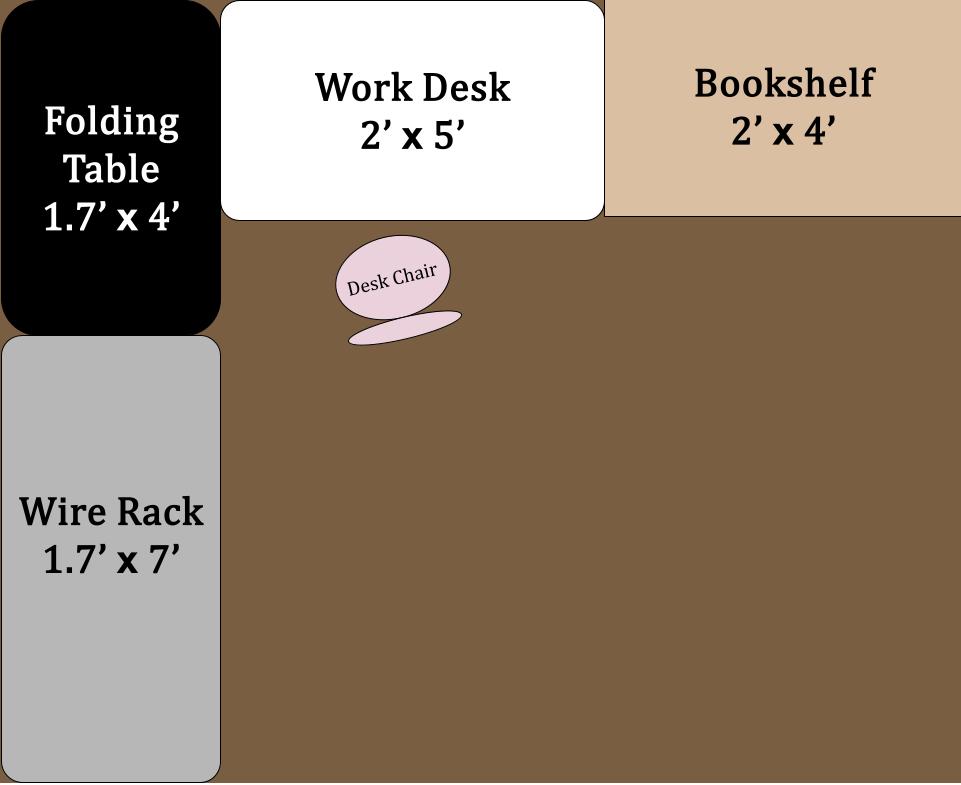
Now, I have done some similar problems to this in the past, so students know that “solve” means be ready to share everything you can learn about this image, like an advanced notice and wonder. What I think this strategy can lend itself to is some other benchmarks and can use this to lead into other problems and connections. I can add on to the question as students solve for all available information. The important part is, students are the ones building to the point where they are multiplying, factoring, using units, converting measurements, and critically thinking about the next piece of information. It is an approach to a higher level task that has a low floor. High school standards I can connect to this concept are: 9.3.6.1, 9.3.6.4 which cover polynomial operations; and 9.2.3.7, 9.3.5.5 which add in the real world elements students are looking for.
If you haven’t yet, you should read through the front matter and look through the glossary, which are linked here: 2022 Math Standards and 2022 Math Standards Glossary and Appendix
In the glossary the area model is defined as a visual representation for students to multiply, divide, factor, and make sense of abstract concepts. Area Model explicitly appears in the new standards explicitly in grades 4 and 5, they are 4.3.5.7 and 5.3.5.1. An example as a visual representation for earlier grades multiplication can be seen here:

Which helps lead into the standards in 4th and 5th grade here:
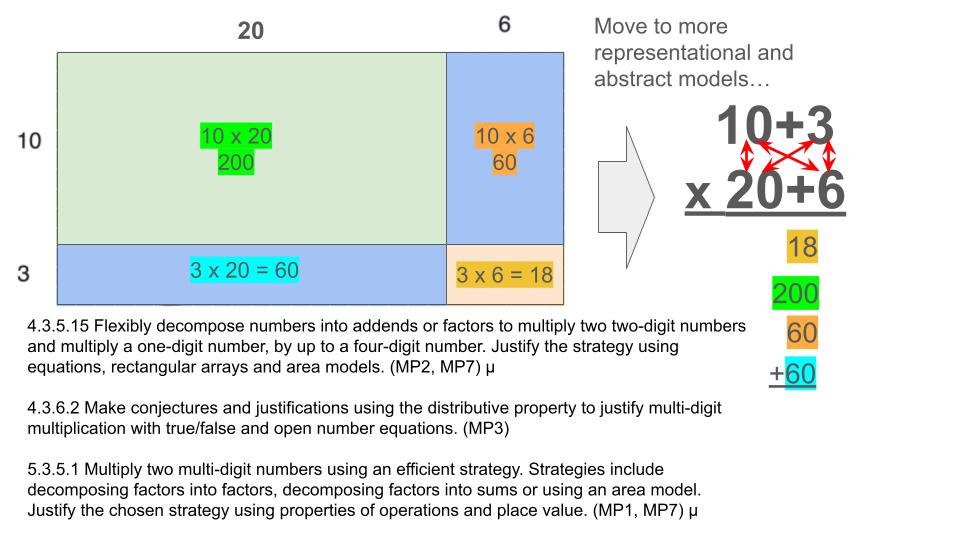
The Area Model is not restricted to these grades and 3 digit number multiplication or polynomial expressions. These can be used even in 2nd grade to see partitioning of a rectangle into a set of squares. The more we expose our students to various representations, the more likely they are to find a method that works for them.
You may not have noticed though that this representation is listed as a component of Appendix L. In the Appendices, Area Models are listed as being in Grades 3-5 as it is within their Benchmarks, AND it is listed for Grades 6-8 and Grades 9-12. This also includes things like Algebra Tiles, which brings in a tangible, physical representation that students can make sense of these concepts.
You may be wondering, how can something be listed in the Appendix for a grade level if it wasn’t listed in the grade level benchmarks? Appendix L is titled “Mathematical Models and Representations” to show a list of strategies and tools to help relate our concepts to our students and connect prior knowledge. You will see a variety of routines in this list, and many of them overlap.
For those of you interested in deeper information on the Benchmarks that list Area Model, there is a great resource on our MCTM Youtube channel where teachers and support like you have created videos diving into the standards for 2022. There is already a great video for 4.3.5.7, along with many others, and more like them are in the works, one new video comes out each week!
We all can have our own sense of problems to connect this with and ways to make this a great conversation in class to link back to as ideas become more and more elaborate and abstract in class. Your students may even be able to come up with some of their own scenarios to write these problems!