
Connecting Standards to Routines and Representations: Rekenreks
by: Sarah Moffett, VP of Elementary
Rekenrek representations (also referred to as math bead racks) have children manipulate a rack with two rows of beads; 5 red and 5 white in each row.
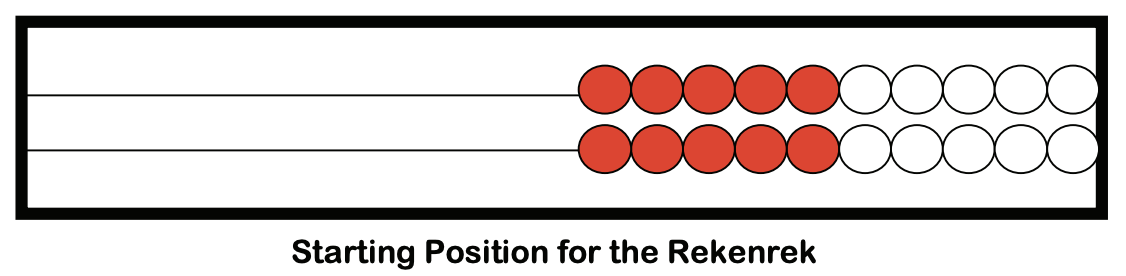
All problems begin with the beads on the right end of the strings. This convention is necessary to ensure that all students begin the problems with the same visualization. Then a leader names a number to be represented Student use their bead racks to show the number. As students grow in familiarity and skill, the teacher encourages students to move beads in clusters with as few “pushes” as possible rather than counting individual beads. Students talk about their choices as they created the number and compare strategies for creating the number.
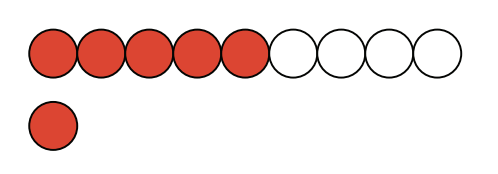
“I made 10 with 9 on the top and 1 on the bottom”
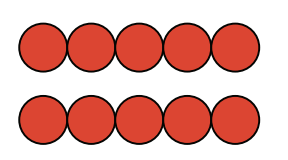
“I made 10 with 5 on top and 5 on the bottom”
Connection to Standards:
Strand 3: Patterns and Relationships and Anchor Standard 5: Number Relationships
Kindergarten
0.3.5.7 & 0.3.5.8— Fluently add and subtract within 5 and Compose and decompose numbers less than or equal to 10 into pairs in more than one way with objects and pictures. Record each decomposition with a drawing or equation.
Honorable mention to benchmarks 0.3.5.1, 0.3.5.5 and 0.3.5.6
Grade 1 & 2
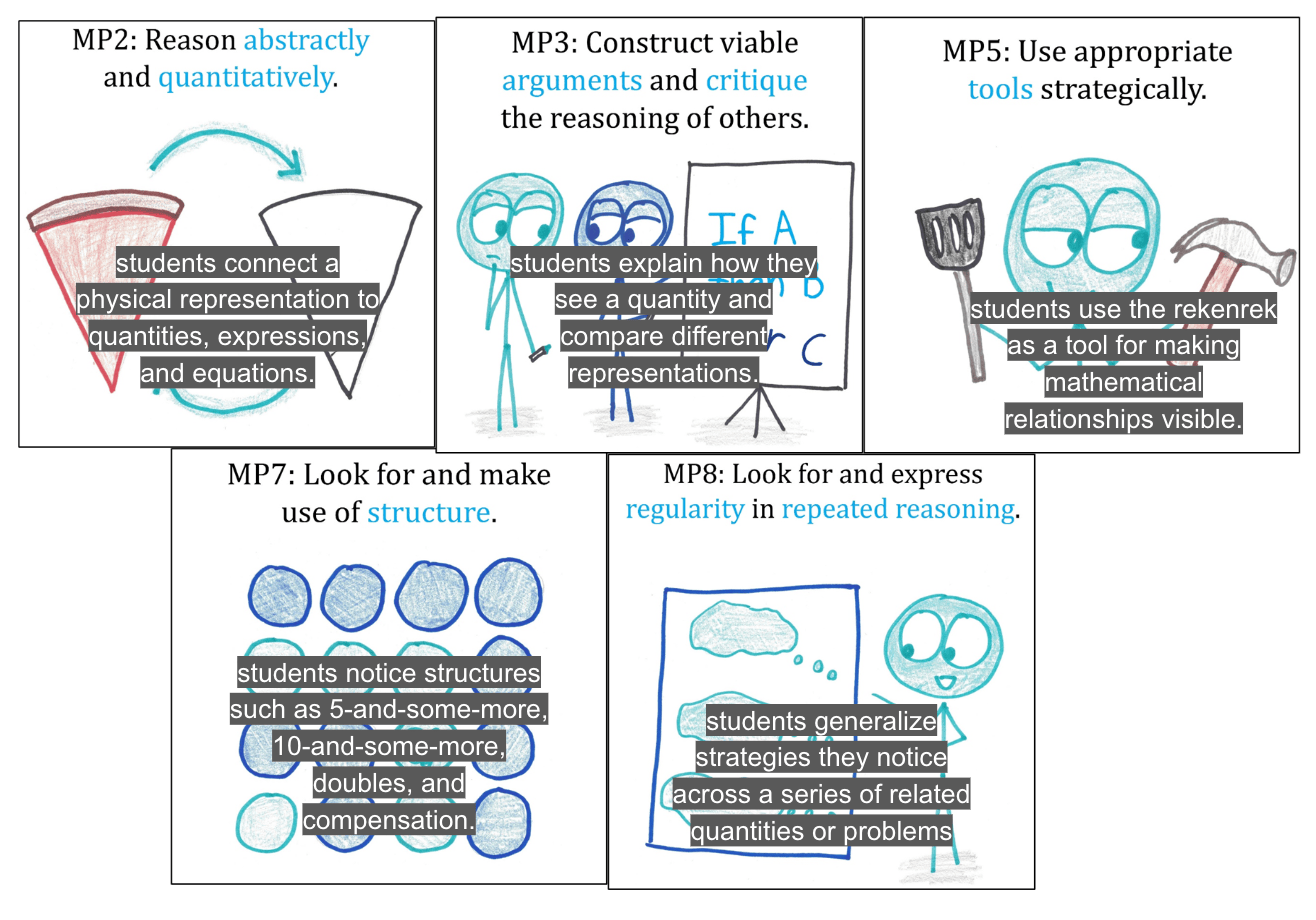
1.3.5.9 & 2.3.5.8— Add and subtract within 20, demonstrating fluency for addition and subtraction within 10. Use strategies such as counting on, making ten, decomposing a number leading to a ten, using the relationship between addition and subtraction, and creating equivalent but easier or known sums. (MP2, MP4) $ # μ Fluently add and subtract within 20 using mental strategies that include incrementing, compensation, or fact families. (MP7)
— Use combinations of 10 to add to the next decade through 100. (MP7) $ Use landmarks of 10 to fluently add to 100 and subtract from 100.
Honorable mention to benchmarks 1.3.5.7, 1.3.5.8, 1.3.5.10, 1.3.5.11, 2.3.5.7 and 2.3.5.9
Grade 3 & 4
Rekenrek routines can support students in moving beyond counting toward landmark numbers, compensation, decomposition, and flexible mental strategies.
3.3.5.7 & 4.3.5.13 — Multiply and divide within 144, using strategies such as equal groups, repeated addition… Fluently multiply two numbers from 0 to 12 using flexible strategies based on the associative, commutative and distributive properties of multiplication. (MP6, MP7)
Honorable mentions to 3.3.6.3, 4.3.6.2 & 4.3.5.15
Author’s Perspective:
In my classroom, using Rekenreks was one of my most powerful tools for developing number sense. It is a complement to number lines and is an invitation for children to think in groups of five and ten.
The visual and physical aspects of the rekenrek support learners at the beginning stages of understanding that one number may be a combination of two or more other numbers. With the Rekenrek, my students quickly learn to “see” in groups of 5 and 10. Therefore, the child will see the number 7 as two distinct parts: one group of 5, and two more. Likewise, the child sees 13 as one group of 10, and 3 more as well as two groups of 5 and 3 more. It helps them develop cardinality, the recognition of a one-to-one correspondence between the number of objects in a set, and the numeral we use to denote that grouping of objects. It taps into their natural capacity to subitize and groupitize to recognize quantities up to 10 (and beyond) without depending on counting by ones. It also sets the stage for conceptual understanding of decomposition as it relates particularly to the operations. It also builds conceptual understanding of Doubling, Halving, One/Two More, One/Two Less.
In later grades, I built upon the strategies used in the 20 bead rekenrek to develop addition and subtraction with larger numbers and multiplication and division.
4 x 6 = (4 x 5) + 4
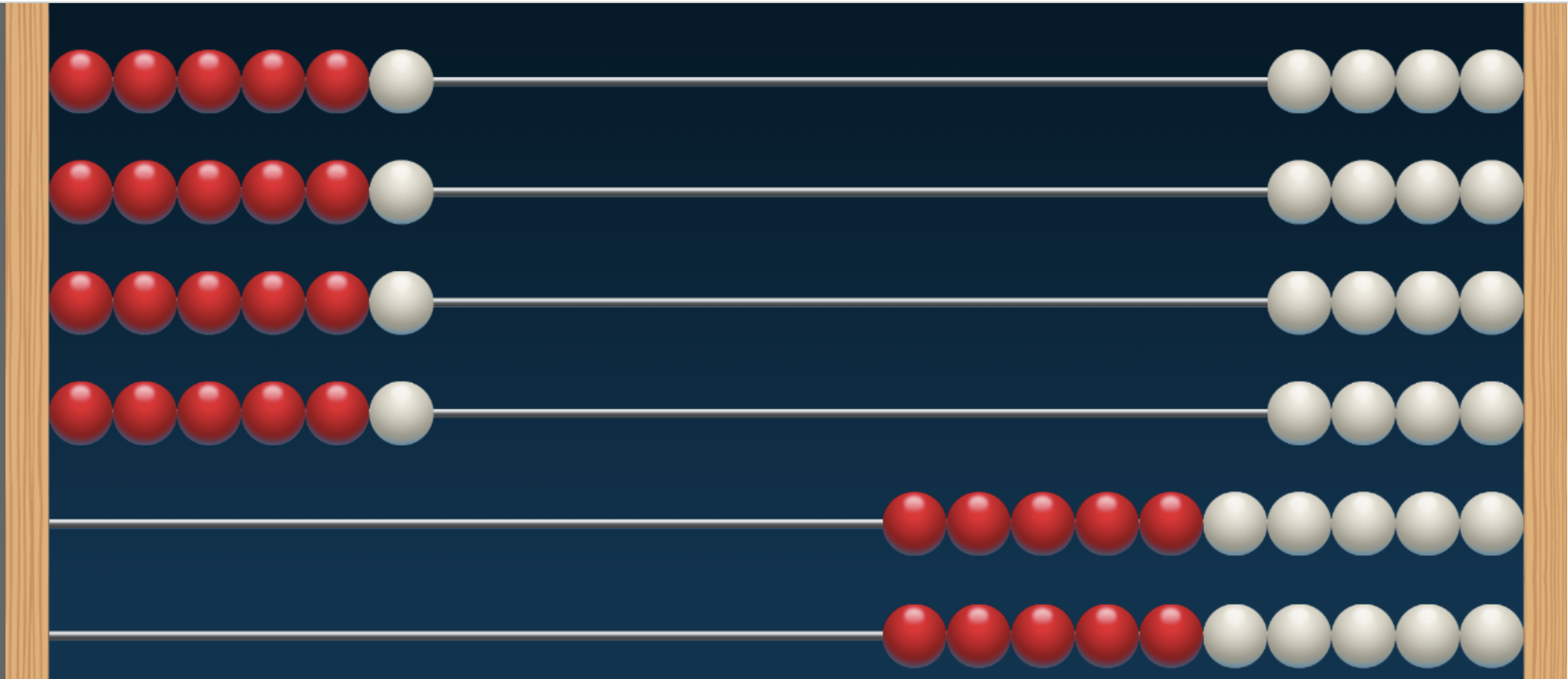
My favorite way to use rekenreks was to play “Guess My Way”. I secretly arrange a number on my bead rack and then ask students to make the same number on theirs. They would share how they made the number, and I say “That’s a way, but it’s not my way”, until we find someone who matches my way of representing the number. Then have students lead the game.
Resources:
Links to any resources readers could use to learn more.
How to Make and Use a Bead Rack for Building Number Sense – Video
Learning to Think Mathematically with the Rekenrek PDF Download
Math Learning Center Bead Rack App (scroll down for informational resources too!)